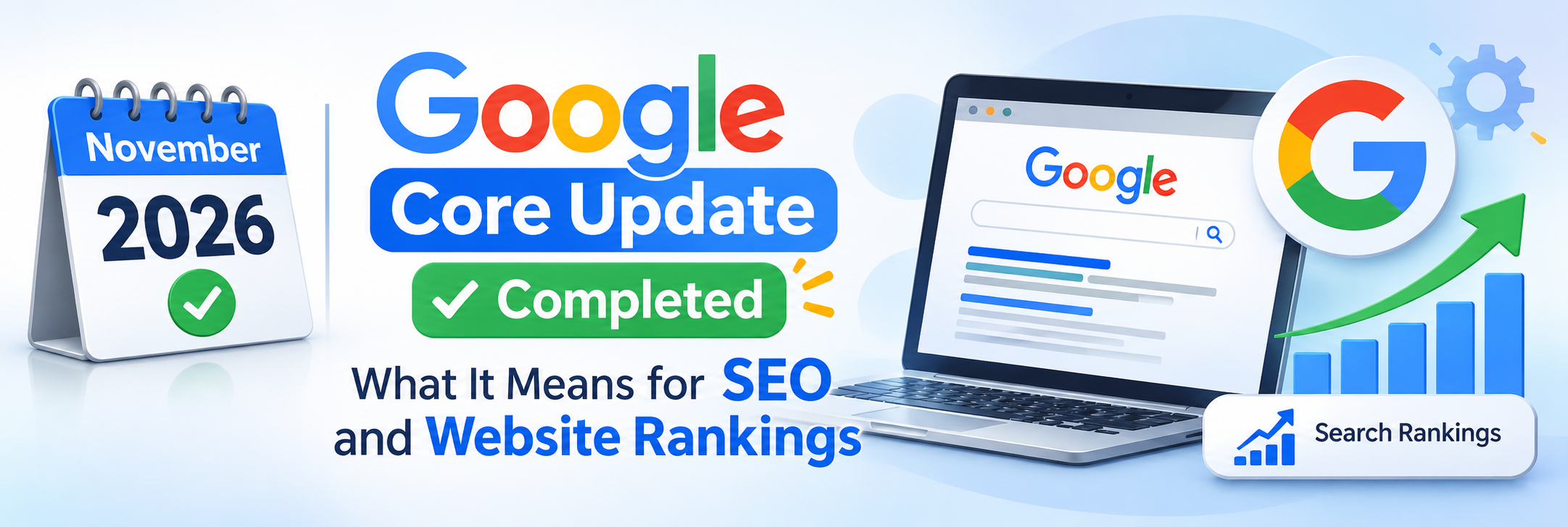
November 2026 Google Core Update Completed: What It Means for SEO and Website Rankings
The November 2026 Google Core Update has officially completed its rollout, bringing an important development for website owners, digital marketers, SEO professionals, and online businesses worldwide. According to Google’s Search Status Dashboard, the update began on November 10, 2026, and was completed on November 24, 2026.
The update affected Google’s Search ranking systems globally and applied to all languages. With the rollout now complete, website owners can begin evaluating changes in keyword positions, organic traffic, impressions, and overall search visibility.
For businesses that depend on Google Search to generate leads, attract customers, and increase online sales, understanding the November 2026 Google Core Update is essential. Changes in Google’s ranking systems can influence how websites appear in search results, making it important to review website performance and maintain a long-term SEO strategy.
In this article, we explain the confirmed update timeline, its potential impact on website rankings, what businesses should monitor, and the practical SEO steps website owners can take after the rollout.
November 2026 Google Core Update: Official Announcement and Timeline
Google confirmed the November 2026 Core Update through its official Search Status Dashboard. The incident was listed under the Ranking category, confirming that Google’s search ranking systems were affected.
Here are the important details:
Update Information | Details |
Update Name | November 2026 Google Core Update |
Announcement Date | November 10, 2026 |
Start Time | 10:06 AM PST |
Completion Date | November 24, 2026 |
Completion Time | 06:03 AM PST |
Coverage | Global |
Languages | All languages |
Affected Service | Google Search Ranking |
Rollout Status | Completed |
Google initially announced that the rollout could take up to two weeks. The official dashboard subsequently confirmed that the rollout was complete on November 24, 2026.
Website owners can verify these details directly through Google’s official incident report:
https://status.search.google.com/incidents/WLxcJyC6jMWMfryxsKMc
What Is a Google Core Update?
A Google Core Update is a broad change to Google’s search ranking systems. These updates improve how Google evaluates and presents relevant, useful, and reliable information in search results.
Unlike updates that target a specific spam technique or technical issue, core updates can affect multiple types of websites, industries, and search queries.
Google’s ranking systems continuously evaluate different signals to determine which pages are most relevant to a particular search. When Google introduces a broad core update, websites’ relative positions can shift as its systems reassess content across the web.
This means a website that previously ranked on the first page may experience a decline, while another website may gain visibility for the same search queries.
Importantly, a ranking decline following a core update does not automatically mean that Google has penalized a website. Core updates are not designed to target individual websites or pages.
How the November 2026 Google Core Update May Impact Website Rankings
The November 2026 Google Core Update is an important development for businesses that depend on organic search traffic. However, the official incident announcement confirms the rollout dates and affected service, not a specific ranking outcome for individual websites.
The following are potential areas businesses should monitor after the update.
1. Changes in Keyword Rankings
One of the first areas SEO professionals should examine is keyword ranking performance.
Some websites may experience improvements in their positions, while others may see certain keywords move down in search results.
For example, a business ranking in the top five positions for a competitive service-related keyword might notice a change after the update.
Website owners should compare keyword positions before and after the rollout rather than assuming that every fluctuation is caused by the update.
2. Changes in Organic Website Traffic
Organic traffic is another important performance indicator.
If a website loses visibility for keywords that generate significant traffic, its organic sessions may decrease. Similarly, improvements in search visibility can create opportunities for additional visitors.
Businesses should examine:
- Organic sessions.
- Search impressions.
- Total clicks.
- Average search position.
- Top-performing landing pages.
- Click-through rates.
Google Search Console provides valuable information for identifying these changes.
3. Changes in Content Visibility
Content quality and usefulness are important considerations when reviewing performance after a core update.
Websites publishing generic, repetitive, outdated, or insufficiently informative material should review whether their pages genuinely satisfy users’ search requirements.
Businesses should focus on creating original, accurate, relevant, and helpful information rather than publishing content exclusively to target keywords.
4. Increased Competition in Search Results
Search rankings are competitive. When the relative visibility of websites changes, businesses may find that competing websites appear above them for important keywords.
This is why analyzing competing pages can help identify opportunities to improve content depth, relevance, clarity, and user experience.
However, copying competitors’ content or making unnecessary changes simply because another website ranks higher is not a sustainable SEO strategy.
What Should Website Owners Do After the November 2026 Google Core Update?
Now that the November 2026 Google Core Update rollout is complete, website owners should focus on evaluating their performance and identifying meaningful improvement opportunities.
Google recommends reviewing search performance after an update has completed and allowing additional time for post-rollout data to become available.
Here are some practical steps to follow.
1. Analyze Google Search Console Performance
Start by opening Google Search Console and selecting the Performance report.
Compare your website’s performance before and after the update.
Pay particular attention to:
- Keywords experiencing significant ranking declines.
- Pages receiving fewer impressions.
- Landing pages losing organic clicks.
- Keywords gaining visibility.
- Changes in average search position.
Avoid making decisions based on one or two days of data. Look for consistent patterns and meaningful changes.
2. Review Your Existing Website Content
Evaluate the pages that have experienced the largest performance changes.
Ask yourself:
- Does the content answer the user’s search intent?
- Is the information accurate and up to date?
- Does the article provide original insights?
- Are important questions answered clearly?
- Does the page offer more value than a basic overview?
- Is the content easy to read and navigate?
If a page contains outdated information, incomplete explanations, or unnecessary repetition, improve it with useful and relevant information.
3. Focus on Helpful, People-First Content
Google’s guidance emphasizes creating content primarily for people rather than search engines.
This means businesses should prioritize their audience’s actual needs.
For example, an SEO agency publishing an article about website optimization should provide practical explanations, useful recommendations, and relevant examples rather than simply repeating popular SEO keywords.
A strong content strategy should prioritize:
- Original information and insights.
- Clear explanations.
- Relevant examples.
- Accurate facts.
- Useful supporting resources.
- Content that satisfies search intent.
4. Improve Website User Experience
Content quality is important, but visitors should also be able to access and understand your website easily.
Review your website’s mobile experience, navigation, page loading performance, readability, and overall usability.
Check whether important pages are accessible and whether visitors can easily find information about your products or services.
Technical improvements should be based on actual problems identified through testing rather than assumptions about ranking factors.
5. Review Internal Linking
Internal links help visitors discover related information across your website and help search engines understand the relationship between different pages.
Review your important service pages, blog articles, and informational resources.
Add relevant internal links wherever they provide additional value to readers.
Use descriptive anchor text that accurately explains the destination page.
Avoid adding irrelevant internal links simply to increase the number of links on a page.
6. Evaluate Your Competitors
Review the websites that have gained visibility for your important keywords.
Compare their content with your own and identify meaningful differences.
Consider whether competing pages provide more detailed answers, clearer explanations, better examples, or more relevant information.
Use this analysis to identify opportunities for improving your own content rather than copying another website’s approach.
Does a Google Core Update Mean Your Website Has Been Penalized?
No. A decline in search rankings following a Google Core Update does not automatically indicate a penalty.
Google explains that core updates involve broad changes to its ranking systems and do not target specific websites or individual pages.
A page may move down because Google’s systems determine that other content provides a more relevant or satisfying result for a particular query.
If your website experiences a decline, avoid immediately deleting pages, changing URLs, rewriting every article, or making large-scale technical modifications.
Instead, identify which pages and queries have been affected and evaluate whether meaningful improvements are needed.
Google’s official core update documentation provides further guidance on understanding ranking changes and evaluating website content.
How Long Does It Take to Recover After a Google Core Update?
There is no guaranteed recovery timeline following a core update.
Some improvements may become visible within days, while other changes can take several months as Google’s systems reassess a website’s content and overall quality.
Google recommends waiting at least one full week after a core update has completed before evaluating the resulting changes in Search Console.
For websites experiencing significant and sustained ranking declines, a broader content and website assessment may be necessary.
The important thing is to focus on meaningful improvements rather than expecting immediate ranking recovery after making a few changes.
SEO Checklist for Businesses After the November 2026 Google Core Update
Businesses can use the following checklist to review their website performance:
- Check the Google Search Console Performance report.
- Compare organic traffic before and after the update.
- Identify keywords experiencing significant ranking changes.
- Review pages that have lost impressions or clicks.
- Update outdated and inaccurate content.
- Improve articles that do not fully satisfy search intent.
- Review internal linking across important pages.
- Check mobile usability and website performance.
- Analyze competitors gaining visibility.
- Monitor organic performance over the coming weeks.
Completing this checklist can help businesses establish a clearer understanding of their search performance and identify areas that require attention.
What Does the November 2026 Google Core Update Mean for Businesses?
For businesses that rely on online visibility, the November 2026 Google Core Update is a reminder that SEO requires consistent monitoring and improvement.
Search engine rankings are not permanent. A website that performs well today may experience changes as Google’s ranking systems evolve and competing content improves.
Businesses should avoid relying exclusively on keyword placement or outdated optimization techniques.
Instead, they should develop a sustainable SEO strategy that combines useful content, technical website health, relevant internal linking, a strong user experience, and regular performance analysis.
Working with an experienced SEO team can also help businesses identify technical issues, evaluate content opportunities, and develop a structured approach to organic growth.
Final Thoughts: Stay Proactive After Google's November 2026 Update
The completion of the November 2026 Google Core Update marks an important point for website owners and SEO professionals.
Google confirmed that the rollout started on November 10 and ended on November 24, 2026, affecting its Search ranking systems globally and across all languages.
Although individual websites may experience different ranking and traffic changes, the right approach is to evaluate actual performance data, review affected pages, and prioritize meaningful improvements.
Rather than reacting to every ranking fluctuation, businesses should focus on building useful content, maintaining a technically healthy website, and delivering a better experience to their audiences.
Need help improving your website’s SEO performance? WebVisualz can help businesses explore SEO strategies, website improvements, and digital growth opportunities. Visit https://webvisualz.com/ to learn more about our services.